Events Details
20
NRS 14500/-(Including all taxes ).
Conference Description
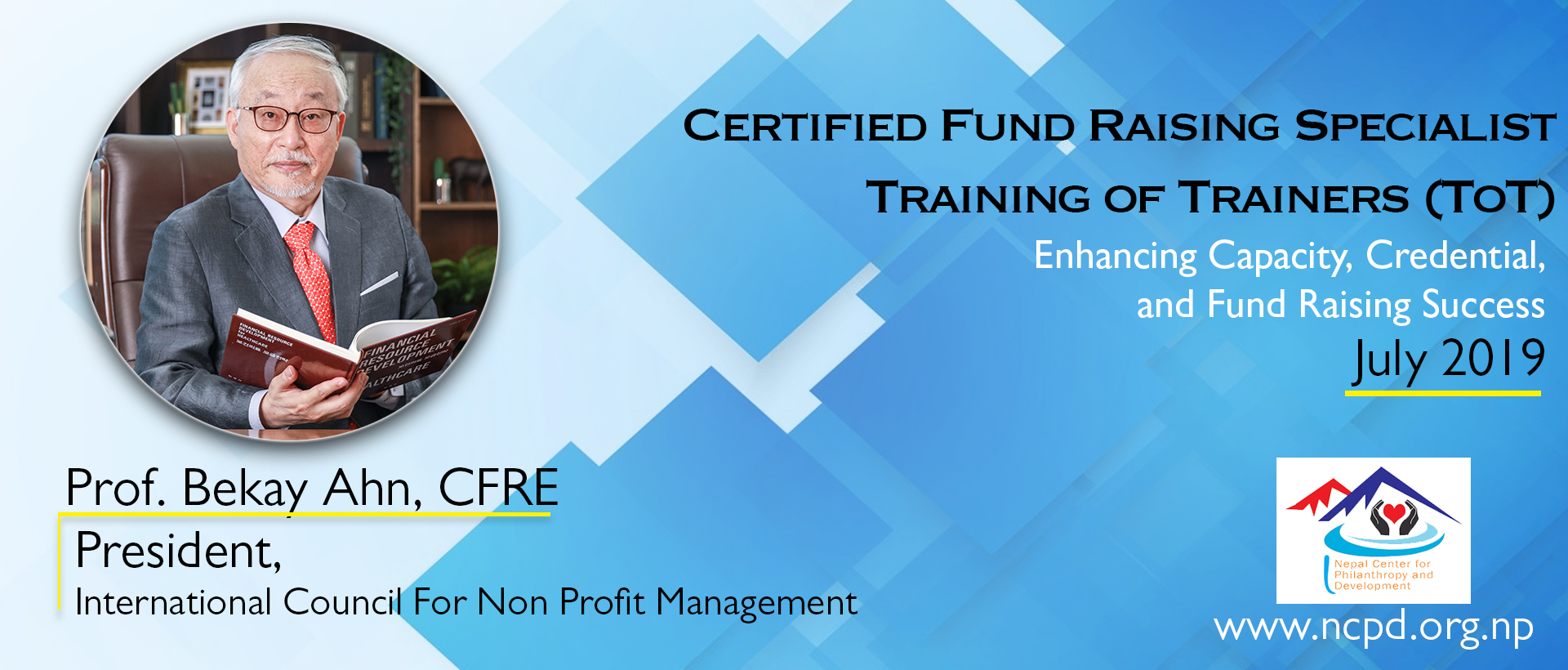
Certificate Fund Raising Specialist (CFRS) Training of Trainers (ToT) is an intensive and internationally recognized professional fundraising course. It provides you the international as well as tailored knowledge, perspectives, tools and techniques and broadens the scope for a splendid fundraising career in the nonprofit world. It also enables you to raise fund for your organization in a competitive fundraising environment.
Certificate Fund Raising Specialist (CFRS) Training of Trainers (ToT) is an intensive and internationally recognized professional fundraising course. It provides you the international as well as tailored knowledge, perspectives, tools and techniques and broadens the scope for a splendid fundraising career in the nonprofit world. It also enables you to raise fund for your organization in a competitive fundraising environment.
Speakers

Mr. Bekay Ahn
CFRE(Certified Fund Raising Executive)
BekayAhn has been working in the nonprofit sector for twenty-five years as an author, lecturer, teacher, speaker and fundraising consultant.
He is the Founder & Principal of the Interna...
Sponsors
Organizer
Nepal Center for Philanthropy and Development (NCPD) is an organization dedicated to promoting the capacity of nonprofit organizations, philanthropies, and private sectors so they could enhance their impact and sustainability. NCPD is also a trusted ambassador and strategic partners of Asia Philanthropy Award, Korean Society of Philanthropy, International Council of Non-Profit Management and participating members of the Certified Fund Raising Executive International.
NCPD has also successfully organized 1st National Philanthropy and fundraising Conference from 27-28, February 2019.
Venue
Hotel Greenwich, Bakhundol, Sanepa, Lalitpur, Nepal
Contact
Mr. Rewati Raman Dhakal
Founder and CEO of NCPD
9842026513, 9803183411
Mr. Bishal Rai
Director of NCPD
9842044215